

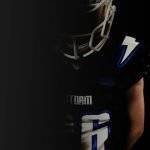
Choosing between dye and sewn lettering is one of the first real decisions coaches make when building a kit. This guide breaks down sublimation vs tackle twill football uniforms so you can pick the look, weight, and maintenance profile that fits your program – then approve a free mockup before anything goes into production.
XROAD Sports offers both methods on made-to-order football kits, with a free design mockup in 48 hours and no minimums. For the full sport landing page, see our hub for custom football uniforms. For why full-dye is a premium finish (not a “cheap print”), read the sublimation quality guide.
Quick definitions
Sublimation dyes color into polyester fibers with heat. Names, numbers, logos, gradients, and all-over patterns become part of the fabric – no thick ink layer sitting on top. The result is lightweight, breathable, and resistant to cracking or peeling through wash cycles.
Tackle twill uses cut fabric letters and numbers that are sewn (and sometimes heat-assisted) onto the jersey. The look is raised and classic – the Friday-night aesthetic many high school and college fans expect. It adds a bit of weight and a different hand-feel versus a fully dyed field.
Neither method is automatically “better.” The right call depends on climate, design complexity, association rules, and how much maintenance your equipment managers will tolerate mid-season.
Side-by-side comparison
| Factor | Full-dye sublimation | Tackle twill |
|---|---|---|
| Where the design lives | Dyed into the fibers | Sewn / applied lettering on top |
| Color and graphics | Unlimited colors, gradients, all-over art | Best for solid letters, numbers, simple marks |
| Weight / feel | Light; fabric feels like fabric | Raised lettering; slightly heavier chest/back |
| Cracking / peeling | No ink layer to crack | Edges can lift if abused; stitches can fray over years |
| Breathability in heat | Excellent for turf and summer camps | Good base fabric; lettering adds local stiffness |
| Classic look | Modern / pro-style when designed well | Strong traditional game-day look |
| Reorder matching | Archive dye files; exact reprints | Archive specs; sew matching letters/numbers |
When sublimation is usually the better fit
- Complex brand systems. Gradients, photo-real crests, sponsor lockups, and multi-color sleeves cost the same to dye as a two-color stripe.
- Youth and summer heat. Lighter hand-feel helps in Gulf Coast climates and long practices.
- Flag, 7v7, and hybrid programs that want sharp identity without heavy applique.
- Durability without patches. Nothing peels because nothing sits on the surface – covered in depth on our sublimation quality page.
If a salesperson calls sublimation “the cheap option,” ask whether they mean bargain heat transfers or professional full-dye. Those are not the same process.
When tackle twill still wins
- Tradition and booster preference. Some boards want the raised letter look for photos and Friday nights.
- Association or school style rules that specify sewn numbers or a particular lettering standard.
- Simple, bold identity. A two-color school mark with large block numbers can look stronger in twill than in a busy all-over dye.
- Hybrid builds. Many teams run a sublimated base (stripes, side panels, pant graphics) with tackle-twill names and numbers for a mixed look. We can mock up either direction – or both – so the board compares apples to apples.
Care, sizing, and reorder reality
Sublimated kits: wash cold, inside out, mild detergent, air dry when possible. No bleach or fabric softener. Because dye is in the fiber, you avoid the crack lines common on surface prints.
Tackle twill: follow the same gentle wash habits and avoid aggressive dryer heat that stresses stitches and adhesives. Inspect letter edges mid-season if athletes are hard on gear.
Either way, measure against the size guide and plan for late adds with no-minimum reorders so a single replacement still matches. Youth-heavy programs can also read our youth custom football uniforms ordering guide.
How to decide in one meeting
- List must-have design features (gradients? photo crest? traditional block numbers?).
- Note climate and practice volume (heat + daily wash favors lighter dye).
- Check rulebooks for lettering requirements.
- Request a free 48-hour mockup of your preferred method – or both – via /kits/#quote or Customize Services.
- Approve the visual, lock sizes, and confirm production timing on the quote. First-time teams can ask about code TEAM10 for 10% off the first order after approval.
That sequence keeps the conversation on your team’s look – not on a catalog guess. The football hub has broader pricing, sizing, and program context for custom football uniforms if you need the full landing page after you pick a decoration method.
Flag Football Headbands → Request a headband mockup
Frequently asked questions
What is the difference between sublimation vs tackle twill football uniforms?
Sublimation dyes the design into the fabric for a lightweight, crack-resistant finish. Tackle twill sews letters and numbers on top for a raised, classic game-day look.
Which lasts longer – sublimation or tackle twill?
Full-dye sublimation has no patch edges to lift, so it often holds cleaner through hard wash cycles. Tackle twill lasts when cared for, but stitches and edges need more monitoring over multiple seasons.
Can we mix sublimation and tackle twill on one football kit?
Yes. Many teams use a sublimated base with tackle-twill names and numbers. We can mock up both options so coaches and boosters compare before production.
Is there a minimum order to try either method?
No. XROAD Sports has no minimums – outfit a full roster or reorder a single matching jersey after artwork is approved and archived.
Ready to compare on your design? Request a free 48-hour mockup at /kits/#quote, or start from the custom football uniforms hub. Call +1 800-940-0567 with questions.
